


U.S. Equity Outlook: Fundamentals, Valuations, and Key Risks
We maintain a constructive outlook for U.S. equities over the next few quarters. Continued economic growth and resilient corporate earnings provide a supportive fundamental backdrop, while equity valuations remain reasonable relative to historical periods. However, we are balancing this optimism with close monitoring of rising government and corporate debt levels and interest rate pressures.
Solid Fundamentals: Economic Growth and Corporate Earnings
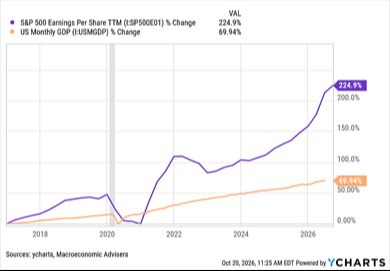
The foundation of the market remains supported by fundamental growth. Ongoing expansion in U.S. gross domestic product (GDP) provides a backdrop for corporate revenue growth, while the resilience of corporate earnings remains encouraging. Over the current economic cycle, trailing earnings per share (EPS) for the S&P 500 have increased substantially, outpacing growth in overall economic output.
We believe this underlying earnings resilience confirms broad market gains are grounded in tangible business performance rather than speculation. While strong earnings provide fundamental support, future results will depend on companies' ability to sustain revenue growth, manage operating costs, and maintain profit margins amid evolving economic and financial conditions.
Valuations: Opportunities Across Market Capitalizations
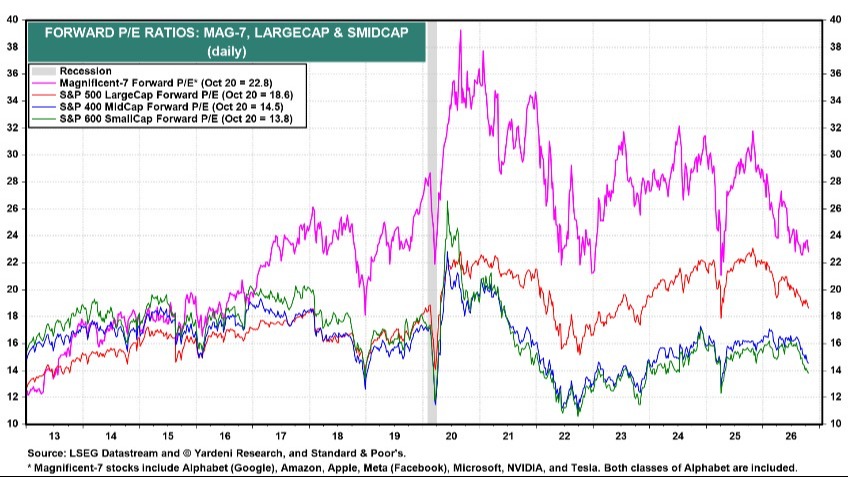
Despite market gains, valuations across the market are balanced. Based on the valuation measures referenced, the mega-cap technology companies commonly known as the “Magnificent Seven” trade at approximately 22.8 times forward earnings, compared with the broader S&P 500 sitting at a reasonable 18.6 times. Further down the market-cap spectrum, opportunities are even more noticeable with mid-cap stocks, as represented by the S&P 400, trading at approximately 14.5 times forward earnings and small-cap stocks, as represented by the S&P 600, trading at approximately 13.8 times forward earnings.
These multi-year valuation resets may offer potentially attractive entry points outside the largest index heavyweights. Accordingly, we believe a selective approach to equity allocation remains appropriate, with an emphasis on evaluating valuations in conjunction with company fundamentals, financial strength, and long-term earnings prospects.
Key Risks: Rising Debt Levels and Borrowing Costs
Despite supportive corporate fundamentals, in our view, rising government and corporate debt levels represent the primary risk to our economic and market outlook. Total U.S. gross federal debt has reached approximately $37.10 trillion, while domestic nonfinancial corporate debt totals have expanded to approximately $15.70 trillion.
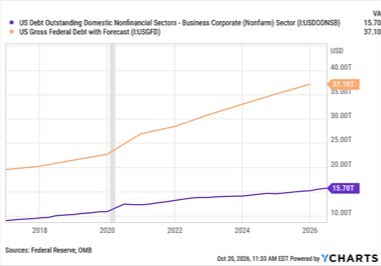
The sheer volume of new bond issuance required to finance both government spending and corporate activity adds upward pressure to long-term bond yields. If elevated bond yields persist or if sticky inflation prompts the Federal Reserve to consider additional rate hikes, the cost of capital will rise further across the economy.
Higher financing costs may affect economic activity and corporate earnings through several channels:
- Consumer spending: Higher mortgage rates and consumer borrowing costs may constrain household purchasing power and reduce discretionary spending.
- Real estate activity: Elevated financing costs may weigh on residential and commercial property transactions, valuations, and development activity.
- Corporate investment and profitability: Higher refinancing costs and capital expenditures may pressure corporate cash flows, potentially leading businesses to moderate investment, hiring, or other spending.
- Equity valuations: Higher interest rates may increase the discount rates applied to future corporate earnings, placing downward pressure on equity valuations, particularly for companies whose valuations depend heavily on anticipated future growth.
These outcomes are not certain, and their magnitude will depend on the persistence of higher rates, underlying economic conditions, credit availability, and the ability of households and businesses to absorb increased financing costs.
Portfolio Positioning and Investment Considerations
In this environment, our investment approach emphasizes financial quality, balance-sheet resilience, and sustainable earnings generation. We favor companies with durable competitive positions, manageable debt obligations, limited near-term refinancing requirements, and the potential to generate consistent earnings and cash flow across a range of economic and interest-rate environments.
We also recognize the role of cash and short-duration fixed-income investments in meeting near-term liquidity needs and supporting a portfolio's more conservative allocation. Higher prevailing interest rates may provide more attractive income opportunities than were available in lower-rate environments, although yields can change and fixed-income investments remain subject to risks, including inflation, interest-rate, and reinvestment risk.
Overall, our outlook for U.S. equities remains constructive, supported by economic expansion, corporate earnings, and valuation differences across market segments. At the same time, we remain attentive to the potential effects of elevated debt levels, borrowing costs, and inflation on economic growth and financial markets. We believe a disciplined, selective approach that considers both valuation and fundamental quality is appropriate in navigating these conditions.
----
Aviance Capital Partners, LLC (“ACP”) is an SEC registered investment adviser located in Naples, Florida. Registration as an investment adviser is not an endorsement by securities regulators and does not imply that ACP has attained a certain level of skill, training, or ability. While information presented is believed to be factual and up-to-date, ACP does not guarantee its accuracy and it should not be regarded as a complete analysis of the subjects discussed. All expressions of opinion reflect the judgment of the authors as of the date of publication and are subject to change. Not all services will be appropriate or necessary for all clients, and the potential value and benefit of the ACP’s services will vary based upon the client’s individual investment, financial, and tax circumstances. The effectiveness and potential success of a tax strategy, investment strategy, and financial plan depends on a variety of factors, including but not limited to the manner and timing of implementation, coordination with the client and the client’s other engaged professionals, and market conditions. This should not be construed as specific investment, financial planning or tax advice tailored to an individual reader. ACP suggests that readers consult a financial professional, attorney or tax advisory professional about their specific financial, legal or tax situation. Past performance does not guarantee future results. All investment strategies have the potential for profit or loss, and different investments and types of investments involve varying degrees of risk. There can be no assurance that the future performance of any specific investment or investment strategy, including those undertaken or recommended by ACP, will be profitable or equal any historical performance level. The index and sector performance data appearing or referenced above has been compiled by the respective copyright holders, trademark holders, or publication/distribution right owners.
Additional information about ACP, including its Form ADV Part 2A describing its services, fees, and applicable conflicts of interest and its Form CRS is available upon request and at https://adviserinfo.sec.gov/firm/summary/146597. For current ACP clients, please advise us promptly in writing, if there are ever any changes in your financial situation or investment objectives, if you wish to impose any reasonable restrictions to our management of your account, or if you have not been receiving at least quarterly account statements from your account custodian.