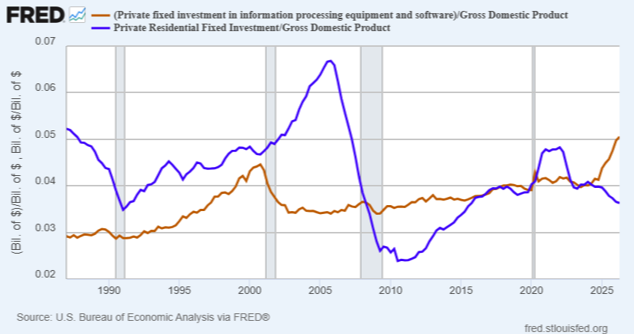
Something big has shifted in the U.S. economy: companies are now spending more money on technology—like business software, servers, and computing gear—than the entire country is spending on building new homes. Historically, homebuilding has been one of the biggest drivers of economic growth, usually soaking up anywhere from 4.5% to 6.5% of total economic activity and easily topping business tech spending. Even during the peak of the late-1990s dot-com boom, business tech spending only reached about 4.4% of the economy, still sitting well below housing.
Today, that script has flipped: higher mortgage rates have slowed homebuilding down to around 3.6% of the economy, while business spending on digital infrastructure and artificial intelligence has surged past 5.0% to record highs. For everyday investors, this means the backbone of the economy is moving away from physical brick-and-mortar assets toward digital tools. While the housing market remains sensitive to mortgage rates and family budgets, major corporations are choosing to keep writing massive checks for tech upgrades and digital expansion. However, this also raises the bar for those companies going forward: because businesses are pouring so much cash into software and hardware, the pressure is now on them to prove that these expensive tech upgrades actually produce real efficiencies and stronger corporate profits down the road.
A key consideration for future growth will be rising interest rates, which push the cost of capital higher for both businesses and consumers. For now, earnings growth remains strong, as does the economy.
. . .
U.S. equities moved higher last week despite continued pressure from elevated interest rates and ongoing uncertainty surrounding inflation. Investors spent much of the week watching to see whether Treasury yields could stabilize after their rapid rise in recent months. While the Federal Reserve's September meeting minutes reinforced the possibility of additional policy tightening, markets largely looked through the hawkish messaging and focused instead on an economy that continues to hold up remarkably well.
What the Bond Market Signaled
Treasury yields remained the dominant theme throughout the week.
After climbing sharply in recent weeks, the 10-year Treasury yield stabilized near 5.25%, ending the week little changed. The pause followed a period in which long-term yields had reached their highest levels in more than two decades, prompting investors to reassess both equity valuations and the broader outlook for monetary policy.
Several factors continued to influence bond markets, including persistent inflation concerns, elevated energy prices, expanding government borrowing needs, and economic data that has generally remained stronger than expected. At the same time, Treasury auctions conducted during the week were met with solid demand, helping ease some concerns about the market's ability to absorb increased government debt issuance.
The fact that yields remained elevated even after softer labor-market data released the prior week suggests investors are increasingly focused not only on inflation, but also on the possibility that economic growth may remain stronger for longer, requiring interest rates to stay higher than previously anticipated.
Higher Treasury yields affect much more than the bond market. They influence mortgage rates, borrowing costs for businesses, and the discount rates investors use to value stocks, which helps explain why movements in the Treasury market have remained such an important driver of market sentiment.
Federal Reserve Minutes Reinforced the Higher-for-Longer Narrative1
The release of minutes from the Federal Reserve's September meeting provided additional insight into policymakers' thinking.
According to the minutes, most officials continue to believe another rate increase may be appropriate before year-end, while nearly all participants viewed inflation risks as tilted to the upside. Several policymakers also expressed concern that strong demand and ongoing investment activity could contribute to inflation remaining elevated longer than expected.
While the minutes did not suggest an immediate need for action, they reinforced a message investors have heard repeatedly throughout the year: policymakers remain committed to restoring price stability and are willing to maintain restrictive policy if necessary.
More than the prospect of one additional rate hike, investors were focused on the broader message coming from the minutes. The Federal Reserve continues to show little interest in easing policy quickly, even as inflation moderates and labor-market conditions gradually cool.
Our Perspective
Last week reinforced a theme that has become increasingly important throughout 2026: higher interest rates, by themselves, have not been enough to derail the economy or financial markets. Treasury yields remain near multi-decade highs, and Federal Reserve policymakers continue to emphasize inflation risks and the possibility of additional policy tightening. Yet despite those headwinds, the economy has continued to expand, and corporate earnings have generally held up better than many expected.
The market's response over the past several weeks has been particularly notable. Even as the yield on the 10-year U.S. Treasury climbed above 5% and the Federal Reserve reinforced its higher-for-longer message, equities have remained relatively resilient. That suggests investors increasingly view rising rates not solely as a threat to growth, but also as a reflection of an economy that continues to perform better than expected.
Looking ahead, investors will turn their attention to upcoming inflation reports and third-quarter earnings results. Those releases should provide a clearer picture of whether inflation continues to move lower and whether corporate earnings remain resilient in a higher-rate environment.
[1] Minutes of the Federal Open Market Committee -- September 15-16, 2026